
What Is FHIR? A Simple Explanation in Everyday Language
FHIR in simple terms so that easily understandable
1/12/20262 min read
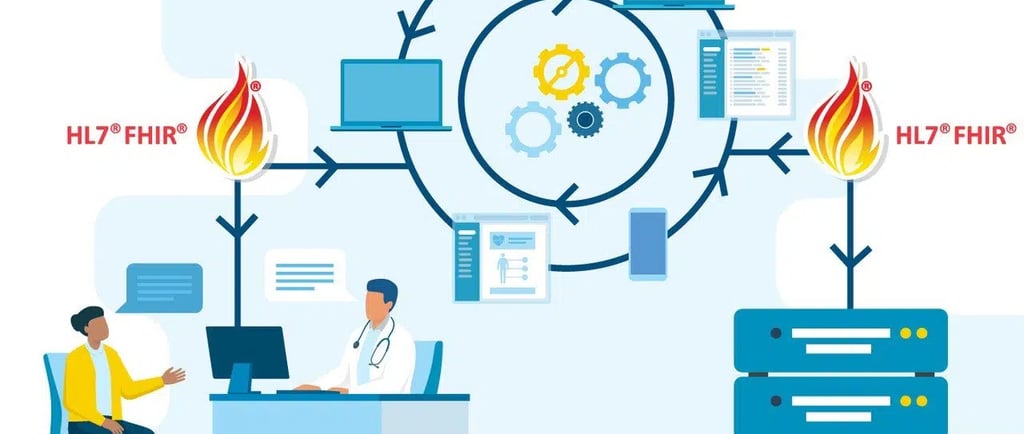
Healthcare data is everywhere — hospitals, labs, pharmacies, insurance systems, mobile apps, and even smartwatches. Unfortunately, these systems don’t always talk to each other easily. This is where FHIR comes in.
This article explains FHIR in simple terms, without technical jargon.
Why sharing healthcare data is hard
Traditionally, healthcare systems were built as closed systems. Each hospital or lab used its own software and its own way of storing data.
Because of this:
Patient data gets duplicated
Reports are shared as PDFs instead of usable data
Mobile apps struggle to access real clinical information
FHIR was created to fix this data-sharing problem.
What exactly is FHIR?
FHIR stands for Fast Healthcare Interoperability Resources.
In simple words:
FHIR is a standard way for healthcare systems to share data using modern web technology.
FHIR works very much like how websites and mobile apps communicate today — using APIs over the internet.
Instead of sending long, unreadable messages, systems exchange clean, structured data.
Think of FHIR like building blocks
FHIR breaks healthcare information into small pieces called resources.
Each resource represents one real-world thing, such as:
A patient
A lab result
A doctor visit
A prescription
For example:
A Patient resource contains name, date of birth, and gender
An Observation resource contains things like blood test results or vital signs
An Encounter resource represents a hospital visit
Because these resources are standardized, different systems understand them in the same way.
How FHIR is used in real life
FHIR is commonly used in modern healthcare applications such as:
Patient portals and mobile health apps
Sharing data between hospitals and digital health platforms
Integrating wearable devices and health trackers
Healthcare analytics and AI systems
For example, a mobile app can use FHIR to securely fetch a patient’s lab results from a hospital system without manual exports or PDFs.
Is FHIR replacing older healthcare standards?
No — and this is important.
Older standards like HL7 v2 are still widely used inside hospitals for day-to-day operations. FHIR does not replace them overnight.
In real healthcare environments:
HL7 v2 handles internal hospital workflows
FHIR is used for modern apps, APIs, and data sharing
Most systems today use both together, with FHIR acting as a bridge to modern platforms.
Why FHIR matters for the future
FHIR makes healthcare data:
Easier to access (with proper security)
Easier to understand
Easier to reuse across systems
This helps enable:
Better patient experiences
Faster integrations
Innovation in digital health and AI
FHIR doesn’t magically solve every problem, but it is a big step forward in making healthcare systems more connected.
A quick note on FHIR versions (past and present)
FHIR has been evolving over time, just like any modern technology.
The first versions
The earliest versions of FHIR were released around 2014–2015. These initial versions were mainly used for experimentation and learning, helping healthcare organizations understand how APIs could work in healthcare.
At that stage, FHIR was promising but not yet widely adopted in real production systems.
The current widely used version
Today, the most commonly used and stable version is FHIR R4 (Release 4).
FHIR R4 is important because:
It is considered stable for real-world healthcare systems
It is officially supported by major EHR vendors
It is commonly used for patient apps, integrations, and data exchange
Most healthcare platforms and modern interoperability projects today are built using FHIR R4.
What about newer versions?
Newer versions like FHIR R5 exist and introduce improvements, but adoption is still growing. Many organizations continue to use FHIR R4 because of its stability and broad support.
In simple terms:
FHIR R4 is the “safe and standard” choice today, while newer versions represent the future.
Connect
Get in touch for collaborations and inquiries.
Follow
srirnld248@gmail.com
+919480992961
© 2024. All rights reserved.